
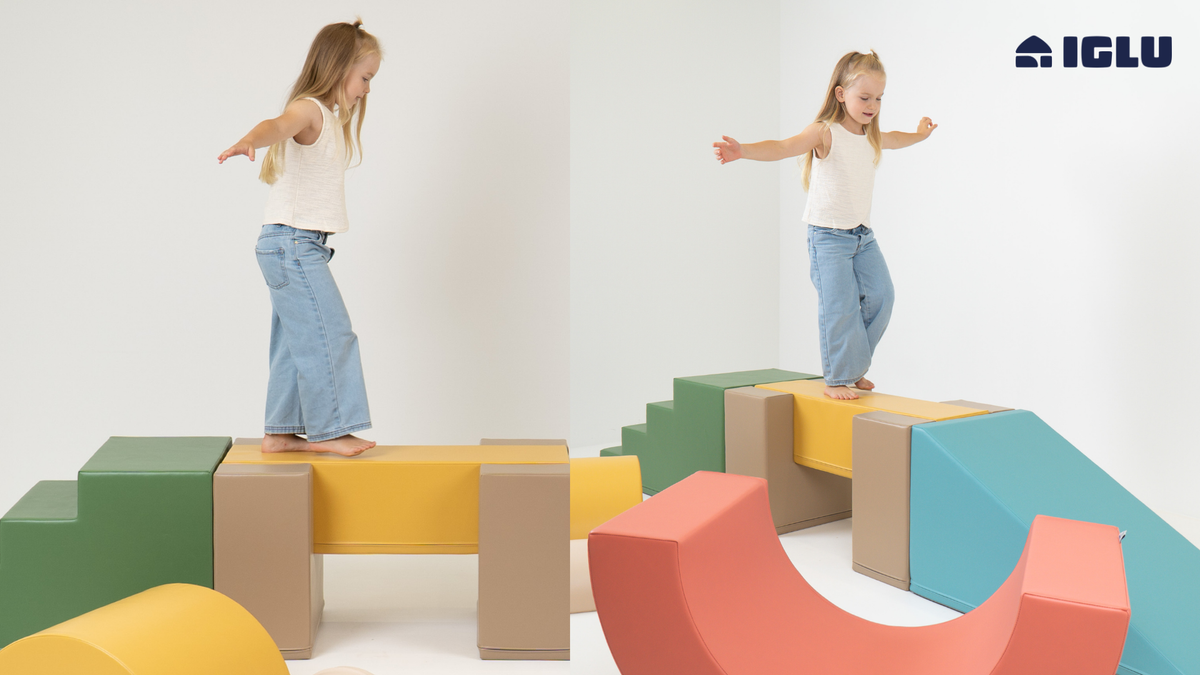
Advice from physiotherapist Sandra Kraukle
In most cases, yes: toddlers fall a lot because they are still learning balance, which develops step by step from head control in the first months to walking along a line by age 5. Falling is part of that learning, and knowing the typical milestones helps you tell what is expected from what is worth checking.
This guide covers what balance is, the typical milestones by age, why falling is part of learning, and the signs that are worth discussing with a specialist. To learn how to support balance at home, read our dedicated post: Balance Play At Home.
What is balance and why does it matter for children?
Balance is the ability to maintain and control your body’s position, whether you are still or moving. It allows us to stay stable, shift our weight, move safely and adapt to changes in our environment, and it is an important component of postural control.
For children, balance is not just the ability to stand on one leg. A systematic review on postural balance in children states that appropriate development of postural control is fundamental for children to reach their psychomotor capacities. Research by Simon Schedler and colleagues suggests that in childhood, well-developed balance performance is the foundation for successfully mastering everyday life and sports activities, and is associated with a lower risk of sustaining a lower extremity injury.
How the body keeps its balance
Balance relies on the brain combining signals from three pathways:
-
Vestibular system: located in the inner ear, it senses gravity, head movement and spatial orientation.
-
Visual system: your eyes track the horizon and surrounding objects to help judge vertical alignment and distance.
-
Proprioceptive system: nerves in your muscles, joints and feet tell your brain where your body parts are positioned without needing to look.
What are the typical balance milestones by age?
Balance milestones arrive step by step as muscle strength and sensory integration improve, and basic balance skills are largely established by age 5.
|
Age |
Typical balance milestone |
|---|---|
|
0 to 6 months |
Primitive reflexes lay the groundwork. Infants learn to lift their heads and eventually sit with support. |
|
6 to 12 months |
Babies sit independently, pull themselves up to stand and begin standing unsupported. |
|
12 to 24 months |
Children take their first independent steps, learn to walk and start balancing briefly on one foot. |
|
2 to 3 years |
Toddlers can run, turn, walk on different surfaces and hop or briefly balance on one foot. |
|
3 to 5 years |
Children master walking on balance beams or curbs, refining their gross motor coordination. |
These ages are typical ranges, not deadlines. The fine-tuning of balance continues well into the pre-teen years. For more reading on this subject, check the CDC developmental milestones.
Is it normal for toddlers to fall a lot?
Yes, falling is a totally normal part of learning balance. Two-year-olds are still learning to run, turn and walk on different surfaces, so frequent tumbles are expected at this stage.
Every fall is part of the learning: through movement, children learn to adapt their body to gravity and to changes in position. The most helpful thing you can do is give your child safe space to practise – for example on a soft, stable surface. That’s much better in the long run than limiting their movement with the best intentions.
If you are worried that your child falls much more often than other children of the same age, see the section on when to talk to a specialist below.
When should I talk to a specialist?
Talk to your paediatrician or a physiotherapist if your child loses skills they had already mastered, or falls much more often than other children of the same age.
Other signs to watch for:
-
Your child avoids physical activity for a prolonged period.
-
Poor balance affects everyday activities – such as getting dressed, squatting while holding an object, or participating in activities with peers.
-
Balance is asymmetrical – your child can stand on one leg but not the other.
-
Balance difficulties come with weakness, stiffness or tremor.
Remember – if something feels off, you do not have to wait, it’s always fine to ask!
Frequently asked questions
At what age can a child stand on one foot?
Children usually start balancing briefly on one foot between 12 and 24 months. By 2 to 3 years, most toddlers can hop or hold a short one-foot balance.
Is it normal for a 2-year-old to fall a lot?
Yes, falling is a normal part of learning balance, as 2-year-olds are still learning to run, turn and walk on different surfaces. Balance develops step by step, and basic skills are largely established by age 5.
How can I help my child’s balance at home?
Through play: safe, varied movement is the best support. For ideas by age check our post on exactly that subject: Balance Play At Home.
A Real Home, A Real Story - Sandra’s IGLU Journey
Balance Play at Home: Physio-Approved Ideas for Kids