
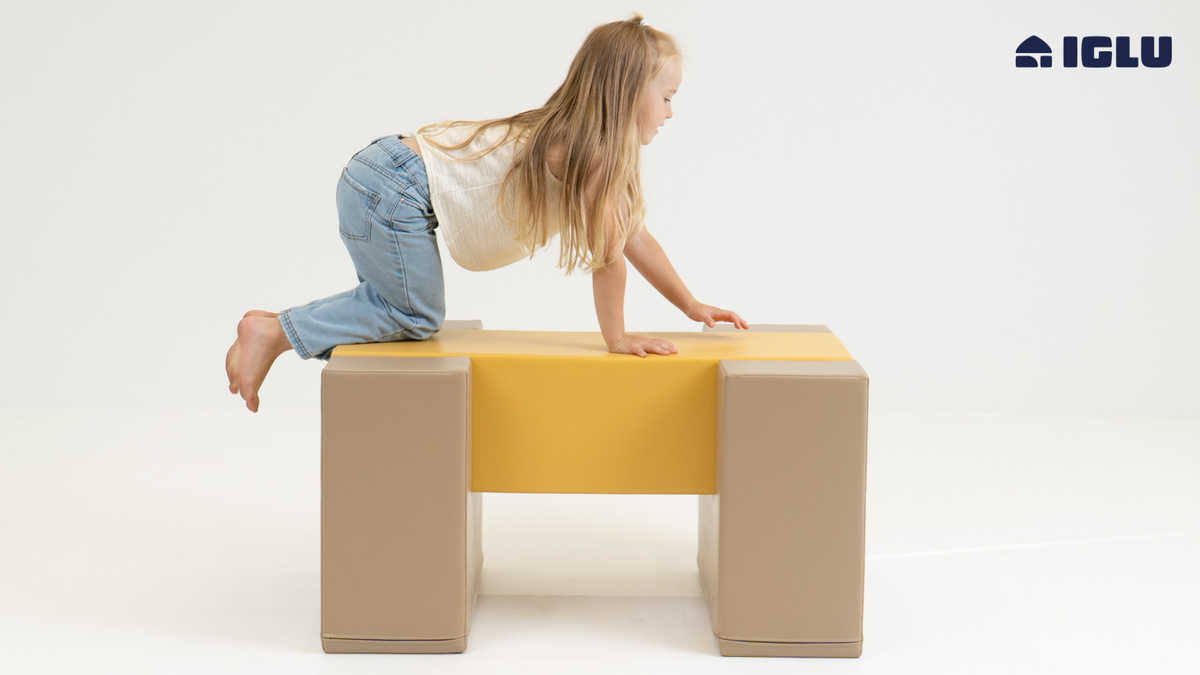
Advice from physiotherapist Sandra Kraukle
The best way to support balance at home is play: give your child plenty of safe, varied movement, from floor time for babies to climbing, walking, jumping and obstacle play for older children. Balance develops through movement, exploration and varied experiences, so you don’t need special equipment to start.
This guide covers how balance develops, play ideas for babies, six play ideas for toddlers and older children, and which soft play sets a physiotherapist recommends. If you are wondering whether your child’s balance is typical for their age, or when to see a specialist, read part 1: Is my toddler’s balance normal?
Why does play build balance?
Balance is the ability to maintain and control your body’s position, whether you are still or moving. The brain builds it by combining signals from the vestibular system (inner ear), the visual system and the proprioceptive system (muscles, joints and feet). Every time a child climbs, rolls, swings or steps over something, these systems practise working together.
Falls and wobbles are part of this process, so the goal is a safe space to practise, such as a soft, stable surface, rather than limiting movement.
How can I support my child’s balance through play at home?
Balance play for babies
In babies, balance is developed through:
-
free movement in different positions: on the back, tummy and sides
-
development of head and trunk control
-
tummy time, which provides an important foundation for postural stability
-
weight shifting, for example supporting on one arm while reaching for a toy, or climbing over obstacles
-
rolling and other forms of early mobility
-
transitions between positions: lying to side-lying to sitting to crawling to standing
-
exploring different surfaces and movement experiences
-
play that encourages reaching, turning, shifting weight and moving
An important principle is to let the baby actively explore movement. That is how babies learn to adapt their body to gravity and changes in position.
Six play ideas for toddlers and older children
-
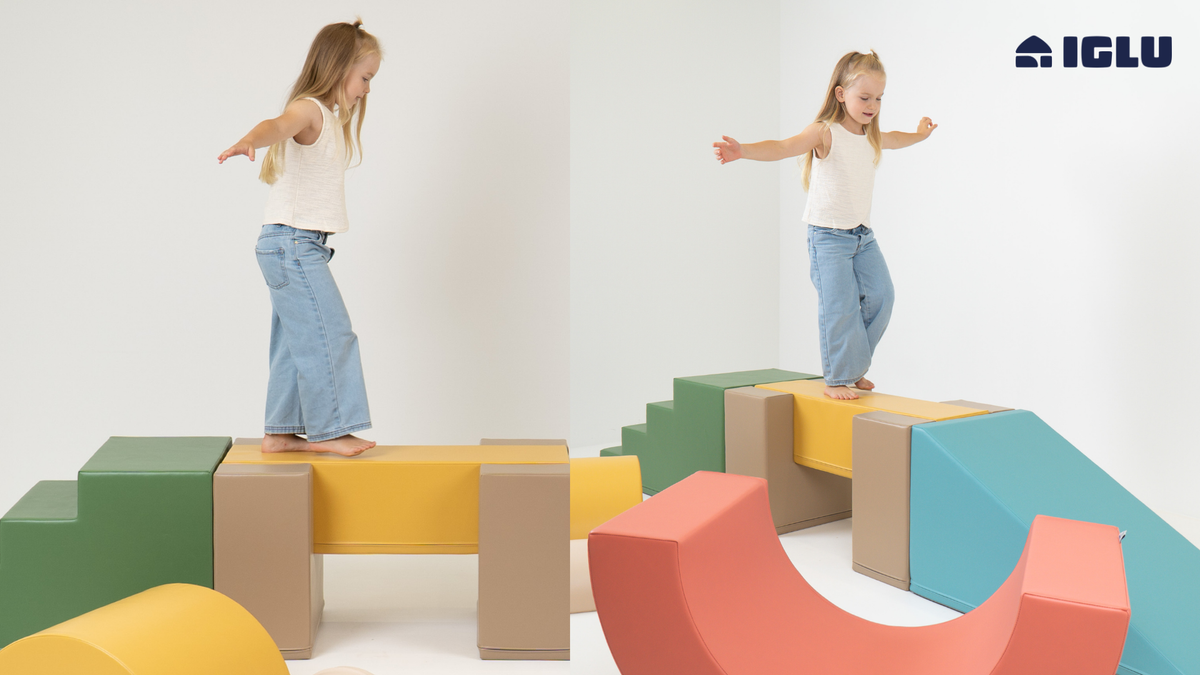
Walk along a line (dynamic balance). Connect 3-4 IGLU blocks into a path and let your child walk across it, then change the direction or the speed. Baby Gym set will do this work amazing. Add Wave shape for additional challenge.
-
Stand like a flamingo (static balance). Ask your child to stand on one leg on a soft, stable surface and hold the pose for a few seconds, then swap legs. You can also try squatting and holding different positions.
-
Climb up and over. Build a low climb from soft pieces and let your child plan how to get up and down safely.
-
Build an obstacle course. Combine crawling under, stepping over, climbing and jumping, and change the layout so your child has to adjust their speed, direction and surface.
-
Swing, slide and rock (vestibular and proprioceptive experiences). Swinging on the rainbow and sliding down the slide of the IGLU Balance Gym give the body new movement sensations. Stay close and supervise.
-
Throw, catch and aim (eye-body coordination). Throw and catch a ball, kick it, aim at targets or play “copy my moves”.
This is why something as simple as an obstacle course can be a great way to challenge balance: a child has to adjust their speed, plan their movements, shift their weight, adapt to different surfaces and respond to changes in the environment.
Which IGLU set is best for balance play?
For babies and toddlers, physiotherapist Sandra Kraukle recommends the IGLU Discoverer Set, and for older children the IGLU Balance Gym. In her own words:
“If I had to choose two soft play sets for balance development, I would specifically suggest the IGLU Discoverer Set and the Balance Gym. The Discoverer Set has a variety of different forms to explore different movements and their own body, which is crucial for balance function, and it is more for babies and toddlers. For bigger kids, the Balance Gym supports both static balance (maintaining different postures and positions on different surfaces) and dynamic balance (walking in line, climbing up and down), and it also gives different experiences for the vestibular system (swinging on the rainbow, sliding down the slide, jumping off the cube).”
Sandra Kraukle, physiotherapist
Both sets are made with Firm Step™ foam, which gives children a stable, safe surface for movement and exploration. They hold their shape reliably, and are easy to clean.
Safety note: jumping off the cube is excellent practice for the vestibular system, but always supervise your child and choose a height that suits their age and ability.
Frequently asked questions
What toys help with balance?
The best toys get children climbing, crawling, jumping and navigating obstacles, while balls for throwing and kicking train eye-body coordination. Even a simple obstacle course is a great way to challenge balance.
Can soft play help with balance development?
Yes, soft play lets children climb, slide and walk across different shapes, supporting both static and dynamic balance. Physiotherapist Sandra Kraukle recommends the IGLU Discoverer Set for babies and toddlers and the Balance Gym for older children.
Is it normal for toddlers to fall while playing?
Yes, falling is a normal part of learning balance. If your child falls much more often than other children their age, see our post on signs worth discussing with a specialist: Is my toddler’s balance normal?
Is My Toddler’s Balance Normal? A Physiotherapist’s Guide to Milestones and Falls