6 Things a Pediatric Physiotherapist Wishes Parents Knew Before Baby Walks
Most of what your baby's body needs in the first two years happens on the floor — and it looks like nothing is happening at all.
After 15 years in pediatric physiotherapy, I still see the same well-meaning mistake almost every week: parents proudly showing me how their 8-month-old can already stand — while the same baby has barely spent time on their belly.
Standing early looks like progress. Often it is a sign that a stage got skipped. Here is what I wish every parent knew before their child takes a first step.
Crawling is not a phase to rush past. It's the foundation of everything that comes after.
Crawling is the first time the two sides of the body have to co-operate — left arm, right leg, over and over. It builds shoulder stability that later shows up in handwriting, and hip strength that shows up in walking.
When a baby skips straight to upright, that work still has to happen. It just happens later, and usually harder.
Standing “early” isn't a win — it's a signal your child needs more floor time.
Parents often tell me proudly that their baby is already pulling up on the sofa at seven months. It can be a good sign. But if most of the waking day is spent in a bouncer, a high chair or an upright seat, standing early often means the floor stages got compressed.
I am not asking anyone to stop a baby from standing. I am asking for more hours on the floor to balance it.
The floor is your child's real classroom — not the couch, not the walker.
Every hour a young child spends restricted — in a walker, a bouncer, or a car seat used as a chair — is an hour they are not moving through the developmental stages their body was designed for.
Floor time does not need to be organised. It needs to be available, every day, for long enough that the child gets bored and invents something.
Bare feet indoors do more for foot development than any “first-steps” shoe.
Those small leather shoes marketed for cruising and first steps — skip them indoors. A pre-walker's feet need to feel the surface underneath them to develop arches and balance.
Every child moves on their own timeline — but they all need the same environment.
Some babies crawl at six months, some at eleven, some skip crawling entirely and turn out completely fine. The age is not the thing to watch. The environment is: can they get to the floor, every day, with something safe to push against?
Play equipment shape matters more than the price tag on the box.
A cupboard full of plastic toys with buttons and songs does not build motor development. What builds it is a small number of open-ended shapes — ramps, blocks, wedges, steps — that a child can climb, push, stack and combine differently every week.
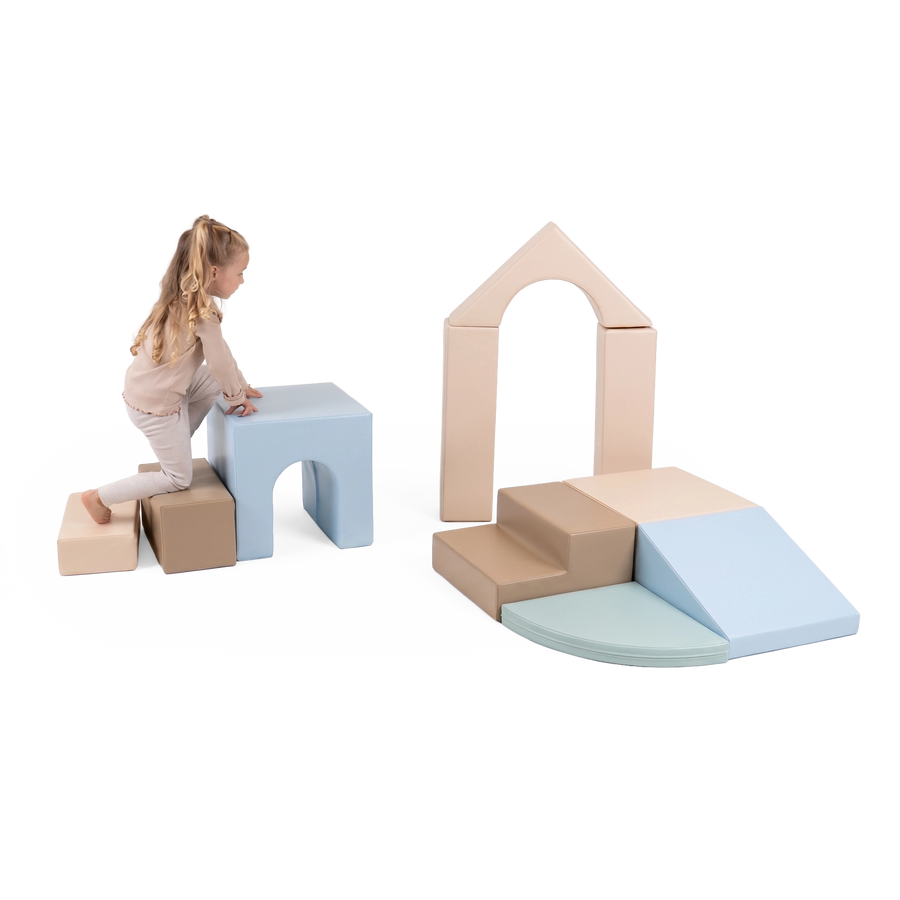
The soft play set built exactly for what I just described
Modular ramps, steps, wedges and blocks — soft enough to fall on, firm enough to push off. It is the closest thing to a physiotherapist's own toolkit that fits in a living room.
- Supports crawling, climbing, standing and walking — from ~6 months through 5 years
- Firm Step™ foam for soft-fall safety and dependable push-off
- Anti-slip bases and hidden zippers — safe for daily unsupervised play
- Certified safe in EU, US, Canada and UK · Made in Northern Europe
Questions parents ask me
My baby skipped crawling and went straight to walking. Should I be worried?
Not on its own. Some babies crawl at 6 months, some at 11, and some skip it and are completely fine. What matters is whether they get daily, free movement close to the floor.
At what age should we introduce soft play equipment?
From around six months, when a baby starts pushing up and moving. Low, soft shapes give them something safe to push against, climb onto and fall off.
Isn't a rug or floor mat enough?
A mat gives a soft surface. It does not give anything to climb, push or problem-solve against — which is the part that builds strength and judgement.
Give your child the floor they were designed for.
Everything above costs nothing but space and time. If you want equipment that supports it, this is the set I point parents to.
Shop the Baby Gym set → Free worldwide shipping · Safety-certified in EU, US, Canada & UK